
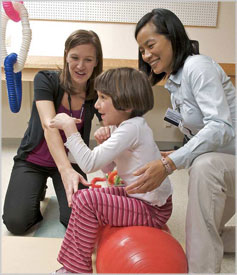
 Physical Therapy Physical therapists (PTs) are highly-educated, licensed health care professionals who can help patients reduce pain and improve or restore mobility – in many cases without expensive surgery and often reducing the need for long-term use of prescription medications and their side effects. PTs use exercises and special equipment to help patients achieve mobility. Counseling Counselors work with students on many different topics. Some use talk therapy or play therapy to assist a child in identifying problems and developing strategies to work through them. Other counselors specialize in working with high school age students and assist them with career and or college decisions. Social Skills Some children have a hard time in social situations. Whether it is in the classroom or at Boy Scouts, some children need explicit directions on how to negotiate a social situation: taking turns, winning and losing gracefully, teasing and being teased. There are professionals who specialize in developing these critical life skills. Academic Tutoring When school becomes challenging for your child, it may be time to consider an academic learning specialist. Learning specialists can assess your child to help you understand what your child knows, and just as important, where there may be some holes in her learning that are causing the learning challenges. Learning specialists then form a plan to help your child develop the skills needed to successfully navigate all her schoolwork. Wrapping it Up It Takes a Village is a real axiom when it comes to raising children. Inevitably a parent will need to enlist the help of a professional when a child hits a bump – however big or small. Understanding there IS help available is critical for parents and knowing some of the educational services professionals provide can help you determine who to contact. Engage the Brain works with many wonderful education professionals who provide an array of services. We would be happy to speak to you and help point you in the best direction for your child. David Karch (Engage the Brain Learning Specialist) Read More
People have been making New Year’s resolutions for thousands of years. It started with the Babylonians, who made promises to their gods at the start of each year that they would return borrowed objects and pay their debts.The Romans began each year by making promises to the god Janus, for whom the month of January is named.
Now a day, most of us try to come up with a few juicy resolutions: I will eat healthier; I will go to the gym; I will start my novel.
And by January 31, many of us have either not started on our resolutions or have given up on them.
How can you make this year different?
Experts agree that in order to achieve a goal two factors must be present. First, write down the goal and keep it in a visible location. And second, tell someone. All the research agrees that by telling someone you are going to do something, you are more likely to accomplish it.

Now that you know the secret to setting and attaining goals, it’s time to bring your kids in on the fun. Late December/early January is the perfect time for the entire family to start a tradition of making New Year’s resolutions. Here’s how you begin:
Gather the family and discuss some possible family resolutions. Some examples are: play board games two times a month; unplug the phones for one hour each night; volunteer one time per month.
Once the family has agreed on one or two family resolutions, it is time to select individual resolutions. Parents ought to act as role models to demonstrate how to choose a resolution. Think about what worked this past year and what areas you would like to improve upon. Literally talk out loud so your child can hear you brainstorm as you reflect on this past year.
Ask your child to come up with two or three resolutions. You can suggest resolutions, but do not dictate. Some suggestions for kids are: keep bedroom clean; read more; help clear the table; walk the dog. Encourage your child to make SMART resolutions: Specific, Measurable, Attainable, Realistic and Time specific. Rather than reading more, your child will read for 15 minutes 4 days a week.
Once your child has selected his resolutions, have her write them down and place them in a prominent location such as on the refrigerator in the kitchen. Each month revisit the resolutions to check on progress. Celebrate successes! If your child is having trouble reaching a resolution, brainstorm with your child on how to better achieve success. Help your child break the goal down into smaller, more manageable steps.
Wrapping it Up
New Year’s is a wonderful time to start over. Engage your child in the ritual of making New Year’s resolutions. Though it may not be a stated resolution, your family may end up bonding during this time of renewal and wind up closer while individually and collectively improving your lives.
David Karch (Engage the Brain Learning Specialist)
Read MoreThe holidays are here, and so is some time off from school. Those first few days are great for everyone. No rushing the kids out of the house at the crack of dawn. No lunches to make or schedules to remember. Peace has descended upon the household.
But, then the bickering starts. First, it’s just a murmur. Then it grows till it’s a full on frenzy. The kids are bored! Ugh!
Don’t fret. There is still time to salvage a peaceful holiday break. The trick? Or in today’s hip language, the hack? Occupying the kids with meaningful holiday activities. Engage the Brain curated the following activities from our family experiences and borrowed a few from the Internet.
Enjoy!
Make a silly holiday photo/card
Just about everyone owns a smartphone with a camera. Gather the family and encourage each person to dress up in their silliest holiday clothes. Think ugly sweaters, silly hats, etc. Add in a few props like stuffed Santa’s, reindeer, etc. Let the photo shoot begin. The kids will love the goofiness of the adults during the photo shoot session.
Research the best hot chocolate recipes… then try them out
Want to sneak in some reading and math over the break? Encourage the kids to go online and research the best hot chocolate recipes. Some call for more expensive chocolate and exotic ingredients. You may want to put a price limit on the total cost; this only adds to the math! Decide which recipes look the best and which one(s) you want to make. Help your kids to read the recipe to determine how much one batch will make. Do you need to double or triple the recipe for each person to get a mug full?
Edible gingerbread houses
Making edible gingerbread houses is always a fun activity. While at the market gather a box or two of graham crackers, a tin or two of vanilla icing, a bag of gum drops, and a mixture of other hard candies. Lie out all the supplies on the kitchen table and give each child a paper plate on which to build his or her house. The graham crackers act as the sides and roof of the house. The vanilla icing serves as the “glue” to keep the house together. The gumdrops and candies are for decorations. Encourage our kids to be creative in their house designs.

Indoor snowball fight
Do the kids need to get some energy out, or do you need to get some aggression out? Stage an indoor snowball fight. Send your kids to their rooms to gather up their white socks. To make a snowball, simply turn one sock inside out and roll it into a ball. Next, make some ground rules. Suggestions include no throwing at some one’s face, no throwing at breakable objects, and no teaming up. Once the ground rules are agreed upon, let the mayhem, um fun, begin.
Ask older family members to share holiday stories
When your family gathers around for the holidays, especially if your extended family gathers, ask older members of the family to share stories about the holidays from their childhood. There could be people around the table born 50, 60, 70 or even 80 years apart. Think about the difference of the world in the 1930’s till today. Not only will your children benefit from such stories, you will no doubt learn something new about your family too.
Wrapping it up
Keeping kids busy is always tricky during the holidays. It can be tempting to shuttle the little ones in front of the television or computer and let them silently pass the time. But with a little preparation, you can balance your sanity and provide entertaining activities for the kids. Once a day over the break, pick one of these activities and enjoy some bonding time with your kids. You might end up making some lasting holiday memories.
Happy Holidays!
Engage the Brain Learning Specialist David Karch
Read MoreLast month we wrote a blog entry about Getting Boys to Read. One of the precipitators to writing that article was a conversation with a parent who felt her son’s lack of pleasure reading had limited his vocabulary development.
That got me thinking. Are there other ways to develop children’s vocabularies even if a child is not a voracious reader? While there is no substitute for reading, it turns out storytelling is a powerful tool that parents and educators can use to enhance a child’s brain development.
In fact, many studies have shown that children build vocabulary, use more complex sentences, and improve comprehension when frequently exposed to stories. The educational researchers Strickland and Morrow say “much of the language children learn reflects the language and behavior of the adult models they interact with and listen to.”
How can we put this research into practice? How about at the dinner table? With the holidays rapidly approaching and the kids out of school for a week or two, this is the perfect opportunity to try some storytelling in your home.
At Engage the Brain, we are parents too. We get what a school year schedule looks like: kids playing sports, clubs, school bands and don’t forget friends. Sitting down to eat dinner, as a family, is a rare occasion. But maybe over the holidays, everybody’s schedule will slow just enough to allow some family meals.
Rather than idly staring at each other making small talk, Mom or Dad, share a story with the family. The tale could be something about your day at work, a family memory, or a scene when you were a child.

If you are not comfortable telling a story, research one ahead of time. Perhaps you could print an interesting article and bring it to the table. Or, you could share a passage from a book you are currently reading. The key to the event is to make the story interesting and ensure it includes challenging vocabulary words. Your child will have a natural curiosity to see where you are going with the story.
Use the inflection in your voice to help your child key into important parts of the story. Drop hints to help your child determine the meaning of unfamiliar words by using context clues. Make it fun, and if you are so inclined, kids love sound effects. Spark your child’s imagination.
In her book Developing Literacy Skills Through Storytelling, Linda Frederic says, “Researchers who study brain and behavioral development have identified imagination, not only as the essence of creativity, but as the basis for all higher order thinking. With imagination, with the ability to understand symbols, create solutions, and find meaning in ideas, young people are more capable of mastering language, writing, mathematics, and other teachings that are grounded in the use of symbols.”
Are you sold?
Wrapping it Up
Storytelling is a fun way to engage the family in a language development activity. Not all kids are natural readers that like to curl up with a book. By sharing fun family stories, reading aloud from favorite books, or even grabbing something of interest off the Internet, children can develop an impressive vocabulary. Go ahead… Give it a try over the holiday break.
Read More With Thanksgiving approaching next week and the kids enjoying a few days off from school, Engage the Brain thought we’d share some of our favorite activities to do in place of watching television or playing video games.
Watching excessive television, whether you are a child or an adult, truly is a bad habit. And as we all know, breaking bad habits can be a difficult thing to do. As parents, setting limits on how much daily, digital media you child can consume is a good place to start.
But rather than focus on all the research and negatives associated with television and video games, we want to suggest some alternatives. Children need direction and suggestions. Start small. Instead of watching one TV program, ask your child to select one activity. That way you are not demanding your child go “cold turkey” for five days.
It’s important to remind parents the power of modeling. Children do what their parents do. Don’t just send your child off to their room to draw a picture while you sneak in another episode of Orange is the New Black on your tablet. Most of the activities listed below are meant to be family activities. They provide opportunities to bond with and learn more about you child’s life away from the home.
The Activities
Talk
Simply sit at the kitchen table or pull up some comfy chairs in the family room and have a conversation. The Children’s Museum of Richmond offers the following prompts to get you going:
- What’s your favorite movie?
- Who’s your favorite actor/ actress?
- Where’s the funnest place you’ve ever been?
- What would you buy with $25?
- If you were invisible where would you go and what would you do?
- If you could be a famous athlete, actor, writer or musician which would you choose and why?
- If you could invent one thing what would it be?
Play Games
Playing cards or board games brings out the competitive fire in even the shyest people. On top of having fun, games provide a great opportunity to model appropriate social skills: taking turns, listening while some else speaks, winning and losing graciously.
Read
Whether it is a physical book or on a tablet or e-reader, encouraging your child to read for 30 minutes pays dividends. Children who read for pleasure consistently outscore those who don’t on standardized tests. And remember: reading is reading so allow magazines, graphic novels (Diary of a Wimpy Kid, anyone?) or comic books.
Paint or draw
Even the least artistic kids enjoy coloring and drawing. Coloring books are inexpensive as are a supply of crayons, markers and drawing paper. Join in the fun. Make self- portraits of each other.
Listen to music
A great way to bond with your kids is to share each other’s music. I’m always excited to be introduced to new musical artists from my daughter. And I’m always anxious to share a new song by an old group that I think my daughter will enjoy.
Play tourist in your hometown
This obviously takes longer than 30 minutes, but during the Thanksgiving week you my find yourself with extra time. Rather than binge watch the Disney Channel, seek out a spot in town your family enjoys visiting. It could be a museum or a park or a historical location.
Volunteer
Another activity that takes longer than 30 minutes, volunteering is a wonderful way for your family to spend part of the holiday week. Seek out a cause that is personal to your family, research organizations in your area, and then make plans to volunteer. It sends so many positive messages to your child.
Wrapping it Up
It’s so easy to turn the television on to watch one program. Inevitably one program turns into two, three or more. Before you know it several hours have past and you will never get that time back.
Start small. Ask your child to replace one 30-minute block of television with one of these activities. Bad habits will take time to break. Embrace the opportunity to rid yourself of unnecessary television viewing. Who knows, maybe by the end of the holidays your family will have reduced its TV viewing and increased its bond and appreciation for each other.
Read MoreI have never been one for listening to motivational speakers or tapes, with the exception of Chris Farley’s SNL character Matt Foley. But when it comes to education and all the criticism currently being leveled at schools, and teachers in particular, I thought it would be a good idea to remind all of us of some of the most basic tenets about raising and teaching children.
In one sense, the thought of teaching a child is overwhelming. The sheer responsibility. And every child learns differently. Now multiply that massive expectation by 20 -25 students in a typical classroom. It is easy to get lost amongst the trees in the forest.
Whether you are a parent or a teacher, we all want to raise happy, healthy kids who become productive members of society. To that end, Engage the Brain pulled together our 15 favorite quotes about education taken from a selection of very smart people.
Everybody is a genius. But if you judge a fish by its ability to climb a tree, it will live its whole life believing that it is stupid.
Albert Einstein
The key to everything is patience. You get the chicken by hatching the egg — not by smashing it.
Arnold Glasow
Teaching kids to count is fine, but teaching them what counts is best.
Bob Talbert
A child’s life is like a piece of paper on which every person leaves a mark.
Chinese Proverb
I like a teacher who gives you something to take home to think about besides homework.
Edith Ann [Lily Tomlin]
If you think you can do a thing, or think you can’t do a thing; you’re right.
Henry Ford
Never help a child with a task that they feel they can complete themselves.
Maria Montessori
What did you ASK at school today?
Richard Fenyman
When educating the minds of our youth, we must not forget to educate their hearts.
Aristotle
The value of a college education is not the learning of many facts but the training of the mind to think.
Albert Einstein
No matter what people tell you, words and ideas can change the world.
Robin Williams
Kids don’t remember what you try to teach them, they remember who you are.
Jim Henson

The apple doesn’t fall far from the tree.
Any teacher is any classroom!
It would do anyone well who works or lives with children to review this list of quotes every so often. There is a lot of wisdom tucked into these words.
If you like the quotes, we encourage you to share them. If you have others you feel belong, please add them on our Facebook page.
In the words of Matt Foley, let’s not let our children “end up living in a van down by the river eating a steady diet of government cheese.” Let’s encourage them to be a source of light and love to and for others.
Read More Rumor has it that this week Florida students and parents will finally receive the much-anticipated Florida Standards Assessment scores from the first round of testing taken this past spring. But what will parents receive, and what do the scores mean?
Engage the Brain will focus on grade levels 3-8 for both the English Language Arts (ELA) and math tests. When you open the envelope, parents, you will want to focus on two scores: The percentile rank and the T score. The percentile rank will tell you how your child did in comparison to the other students who took the test in the same grade level. For example, if your child receives a 68 percentile score that tells you your child did better than 68 percent of the students who took the test. Conversely, 32 percent of the students who took the same test did better than your child.
T scores are a little trickier to understand. They are essentially another way to report a percentile score. The T scores are reported on a scale of 20 – 80 with 50 equaling the 50 percentile. On the graph below, the sd stands for standard deviation, which is the amount of variation in a set of data.
You will be able to see how many questions there were in each sub-section of the tests and how many questions your child answered correctly; all useful information.
What will be missing are the proficiency band scores ranging from a low of 1 to a high of 5. The state has not finalized the ranges yet. On the FCAT, the FSA’s predecessor, a score of 3 was deemed proficient or on grade level.
Where the state places these proficiency bands is critical. Make the bands too tough and too many students will fail the test. Make them too easy and the test looks foolish. School grades and teacher evaluations also ride on the scores.
Many common sensed individuals have called for a high stakes moratorium for one year. They say, ‘Don’t use the scores to determine school grades or teacher evaluations.’ These same people have asked to use the first implementation of the test as a baseline only. Then next spring the state will have scores to compare the second round of tests to, comparing apples to apples.
This January the Florida Department of Education is to finalize the scoring bands. Presumably parents will receive a follow up report to the one they will receive this week informing them of their child’s proficiency score.
Should you have any questions about your child’s FSA scores, Engage the Brain would be happy to discuss the results and answer any questions.
Read More It’s a pretty well known fact that boys do not like to read. Parents with the best intentions read aloud to their sons just like they did to their daughters from the time they were babies. The kids successfully learn to read by first grade and everything seems good.
Then schools start giving standardized tests in elementary school and suddenly a gender-performance gap appears. According the U.S. Department of Education, over the last 30 years boys have continued to score worse than girls on reading tests in every age group, every year.
What gives?
The Guys Read website lists the follow possible reasons:
- Biologically, boys are slower to develop than girls and often struggle with reading and writing skills early on.
- The action-oriented, competitive learning style of many boys works against them learning to read and write
- Many books boys are asked to read don’t appeal to them. They aren’t motivated to want to read.
- As a society, we teach boys to suppress feelings. Boys aren’t practiced and often don’t feel comfortable exploring the emotions and feelings found in fiction.
Boys don’t have enough positive male role models for literacy. Because the majority of adults involved in kids’ reading are women, boys might not see reading as a masculine activity.
So how can you get your son to read? Engage the Brain investigated the Internet and collected the best suggestions.
Be Realistic and start small
Say to your son, “Here is one book, one magazine, one article, one website you might like.”
Expand definition of reading
Non-fiction, humor, graphic novels, action-adventure, magazine and websites all count as reading.
Read aloud
Most parents are guilty of stopping to read aloud once their child begins to read independently. Boys AND girls benefit from continuing to read aloud to them through the elementary–age grades. Take turns reading pages in a book and discussing the plot and characters. Make it fun.
Pair books with activities
Boys by nature are active. Encourage your son to act out a scene from the story. Take out a cookbook with your son’s favorite recipes and read through the ingredients and instructions. Then make one as a follow up activity.
Find male role models
Boys typically do not have many male “reading” role models because most elementary teachers are women. Boys need to see men reading. Dads, older brothers, uncles, grandfathers, coaches…this means you! Boys need to see men reading to understand it is socially okay to like to read.
Family book club
Start a family book club. Encouraging several members of the family to read the same book can serve as motivation (and role modeling) for boys to want join in the fun. Plan to watch the movie version of the book on a Friday or Saturday night.
Use a reading log
Seeing is believing. By asking your son to keep a reading log, he will see his progress. The log can be simple: book title, author and genre. By reviewing the log your child can see the types of reading material he likes – action, biography, humor, etc. Plus, keeping a reading log may kick in your son’s competitive juices and want to compare his reading log with his friends reading logs. Remember – boys are competitive.
Conclusion
There is clear evidence boys are falling further behind girls when it comes to reading. Anyone who works in education has heard the following refrains from boys, “I don’t like to read” or “There is nothing good to read.” It takes effort and an adjustment, but boys can and will read for enjoyment. Be persistent and try one, two or all of these strategies.
Happy reading!
Read More Attention Deficit Hyperactivity Disorder (ADHD) is a growing concern in homes and classrooms across the country. If you are a teacher, you know the child and symptoms all too well. You just finished a fantastic lesson on adding fractions and your active sweetness siting at a desk by himself asks, “Mrs. K, how often do you cut your fingernails?”
Parents at home may see other evidence of ADHD. Struggles to keep the bedroom clean. The inability to manage the time necessary to complete all the homework each night. Or, the appearance of not being able to follow directions with more than one step.
Too commonly, doctors and parents are choosing to treat ADHD with medication. According to the Center for Disease Control (CDC), diagnosis for ADHD has increased 43% between 2003 and 2011. And ADHD medications can have serious side effects including sleep problems and weight loss.
Before we go any further, it is important to note that some children NEED medication to perform in school and keep pace academically and socially with their peers. The questions for these children become which is the best medication and what is the right dose?
Having said that, not every child NEEDS medication. This determination is best made in consultation with your child’s doctor AND classroom teacher. Your child’s teacher is an important piece of the team because she interacts with your child on a daily basis. Additionally, she may have the experience to compare your child’s classroom behaviors with other children she has taught and can provide you with an objective barometer to measure possible treatments and interventions.
Engage the Brain studied the research on alternative treatments to ADHD medications and discovered the following possible options:
The Feingold Diet
The diet is essentially an elimination diet where certain food colorings, flavorings and preservatives are removed from a child’s diet in hopes of lowering hyperactive behavior. Scientific studies have disproven the effectiveness of the diet, but some parents have witnessed success.
Supplements
Some research suggests adding certain supplements to your child’s diet can help mitigate the symptoms of ADHD. Zinc, L-carnitine, Vitamin B6 and magnesium have all shown degrees of effectiveness.
Electroencephalographic biofeedback or EEG
EEG attempts to treat the brainwaves in an effort to promote your child’s ability to focus. EEG employs video games that are directly connected to the child’s attention. While playing a game if the child’s attention begins to waver, the screen may go dark or the game may slow down. This triggers the player to reengage his focus and the screen brightens back up or the game speeds back up.
Yoga or Tai chi
Are you a parent that likes to practice yoga? If so, bring your active child with you the next time you visit the dojo. Teenage boys who practice yoga or Tai chi twice a week report being better able to concentrate. These practices teach relaxation and discipline.
Exercise
Exercise is Mother Nature’s gift to the ADHD community. 30 minutes of active play is as effective as some ADHD medications. And exercising outside adds to the benefit.
Wrapping it all Up
It certainly seems like more and more children are presenting symptoms of ADD/ADHD. The CDC’s report of a 43% increase in diagnosis backs this up. Many doctors and parents are quick to tap medication to correct the problem. And while some children will need medication to assist them in managing their ADHD symptoms, NOT ALL children do. Use this post as a springboard to start a conversation with your child’s pediatrician. Look into these treatments in more detail.
As a parent, have you tried an effective, alternative treatment for ADHD with your child? If so, we would love to hear about your success story.
Read More
To keyboard or not to keyboard, there is NO question! 21st Century students need to learn how to keyboard. And not only just how to type. They must learn all the basic functions and maneuvers required to operate a personal computer.
Many elementary school educatorssuggest that third-graders should learn the keyboard layout and understand the function of the space bar, delete and arrow keys; know how to click and tap; grasp how to cut, paste and highlight; understand how to scroll; know how to select and unselect an object, text or area; and be able to drag, slide and drop selected material and use drop-down menus.
Not coincidentally, the new Common Core state exams such as PARCC require students to use these same computer skills to demonstrate what they have learned placing even more importance on learning computer literacy skills. The CCSS include two benchmarks: use the Internet for research and use digital tools for learning.
Children will NOT learn keyboarding through osmosis or repeated exposure to the keyboard while playing. It takes systematic instruction. “Look at how anything complex is taught,” says Lauren Eve Pomerantz, an educator at California Space and Science Center. “We take words and break them into phonemes to teach reading. We take dance and break it into sequences of steps to learn ballet. We take music and break it into scales to learn to play an instrument. Knitters make squares in a pattern until they are ready to incorporate it into a project.” Keyboard instruction is no different.
A few of the required skills are:
- Eye hand coordination
- Finger isolation
- Good finger sense or propioception (knowing where your fingers are in space)
- Working memory
- Bilateral coordination (using both hands in a coordinated manner)
- Sustained Attention
- Good sitting posture
Depending on the frequency of practice and general ability of the student, it takes 6 months to a year to become proficient at keyboarding. And the great news is there are plenty of FREE programs available for children to select from to learn.
Here are a few of Engage the Brain’s favorite programs:
Typing Pal “Dynamic and stimulating, Typing Pal Online offers a personalized approach to learning keyboard skills. With nothing more than a web browser and a subscription, you can make rapid progress by benefitting from the most up-to-date games and exercises.”
Typing Agent “Let’s face it, learning to type is imperative to be successful in today’s modern culture, but let’s not forget about the fun! Research shows that fun is serious business for students; the more engaged they are the more they learn, but fun is just the tip of the iceberg!”
Dance Mat Typing “It is interactive, fun, free and easy-to-use for kids; the system is complete with animated animal characters, graphics and sounds. We provide friendly menus or lists and other cool stuff to make it easier for you and your kids to use Dance Mat Typing to effectively learn how to type.”
Wrapping it Up
Keyboarding skills are a must in today’s digital-centric world. Virtually any job requires some knowledge of computers and minimum level of proficiency at keyboarding. Most schools do not have the time to teach keyboarding as a class. Research shows it takes a systematic approach of daily instruction and practice to learn how to keyboard.
These are three programs that are available to parents to help their child learn how to keyboard. Pick one and start your child today. They will thank you for the rest of their life.
Read More